Missing the Point With Social Media
Monday, November 23rd, 2009By Kathleen Hosfeld
As much as organic models of organizations may be taking root, and the industrial metaphor of “business as machine†may be dying back, the latter lives on in marketing. As a result, many companies may be missing one of the biggest opportunities of social media as a tool for growth and profitability – supporting authentic relationships.
In the industrial paradigm, marketing is a machine that makes sales. Depending upon how many resources one plugs into the machine, one can turn a crank and expect sales as an outcome. The machine pumps messages through pipelines directed at target audiences. The messages fall upon the target audiences, a portion of which respond. It’s believed that the more resources one puts into the machine, the more sales occur. The problem is that many companies feel the machine has become unreliable. They are putting more and more resources in, and getting fewer and fewer sales as a result.
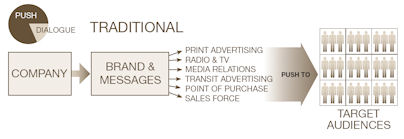
A Machine That’s Running Down
Continuing to conceptualize marketing with this metaphor is to ignore many cultural shifts that point to change. The emerging metaphor depicts marketing as a series of co-creative dialogues with stakeholders. A book published a decade ago, The Clue Train Manifesto, put this idea on the map: “Markets are conversations.†Mutually constructive dialogue builds trust, which leads to sales.
The traditional paradigm of marketing is a push model, where target audiences are passive receptors (or at times victims) of marketing campaigns. While most good marketers understand the role of dialogue, in the push model it’s a relatively small part of the overall mix.
Strengthen Your Core
In the trust paradigm, marketing starts as dialogue with a core group of stakeholders that share the company’s passion for its products or services. This core group can be viewed as the center of an ever-widening series of relationships, depicted as concentric circles (but not nearly as neatly categorized). In the center of the circle, the relationships with the company are the strongest and are the most likely relationships of advocacy. As word of the company and its products or services travel outward through layers of connection, the marketing message is propelled by the network’s relationships with each other rather that a direct interaction with the company.
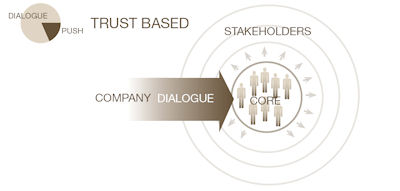
What gets lost for many companies is the importance of cultivating that inner core. One of the important tasks for companies is to determine who the key stakeholders are. Who lives in the center circle? And what do they need to be advocates for the company? Traditional marketing focuses primarily on customer prospects, but employees and other stakeholders are often part of the core.
In his book, The Gort Cloud, author Richard Seireeni notes that many of today’s successful green brands used little or no push strategies during their start-up phase. Contrast this with the start-ups of many of the dot.com companies in the ‘90s that spent millions on brand awareness and mass media (many failed). The companies in Seireeni’s book didn’t have those funds and couldn’t grow that way. Instead they cultivated a network of advocates – employees, suppliers, specialized journalists – that grew steadily until the companies reached critical mass and were able to scale.
Pushing less
What’s the role of “push†tactics – traditional advertising and promotion – in a trust-based paradigm? Increasingly such tactics focus on permission-based or “opt in†techniques like search marketing and social networking. Even when a company is doing all it can to collaborate with its core, there may always be a role for push strategies that invite people into permission-based relationships. The degree to which this is necessary will vary by industry. The point is that push strategies and their associated costs will diminish as a percent of marketing budgets and activities.
Unfortunately, many of the organizations using social media don’t recognize this paradigm shift. They are using social media as another form of push marketing, instead of a tool for dialogue. It’s a step in the right direction to convert to permission-based or opt-in communications with prospects or customers. If that’s where social marketing ends, however, a great opportunity for relationship and mutual advocacy is lost.
Who’s Your Primary Relationship?
Using social media only as a push strategy places the emphasis on customers’ or prospects’ relationships with each other, rather than their relationship with the company. Building a sense of community around your products or services is a great thing to do – it’s what makes Harley Davidson, as one example, as successful as it is. These communities take the company’s message out through viral networks. This works best, however, when the company is an integral part of that community and strong relationships have been established at the core.
What are some ways to capture the benefit of social marketing to foster authentic relationships?
Start With Face to Face Dialogue With Core Stakeholders – Identify your core stakeholder groups. Who cares deeply and passionately about your product or service? Design in-person, face-to-face conversations with people who are core stakeholders. This certainly will include employees, some customers or clients (but not all), suppliers, regulators, distributors, etc. Adopt a position of mutual learning. Nurture these relationships over time.
Use Social Networking to Continue and Broaden the Conversation – After establishing key issues with your core stakeholder groups, invite more people into conversations on those issues. Include feedback options social marketing campaigns. These can take the form of polls, surveys, discussion groups, etc.
Networks That Connect Other Stakeholders – Many of the free social networking resources are more appropriate to prospective customers or customers. Remember to support ongoing dialogue with other stakeholders through online collaboration software or other technology appropriate to those audiences.
Not Everyone Uses The Web – While many people do enjoy connecting online, there are many high-value contacts that don’t. An inclusive approach that designs opportunities to connect in person in person or on the phone will ensure you do not miss important customer segments.
Don’t Spread It Too Thin – Nurture the core. Remember Gerald Weinberg’s Law of Raspberry Jam: “The wider you spread it the thinner it gets.†Keep in mind that the mass communication doesn’t take the place of face-to-face in creating a core of committed advocates.
Many younger companies have used this model because they didn’t have the money to do it any differently. Yet for decades, companies with diverse clients – from highly affluent individuals, other businesses, athletes, foodies, and more – all have gone to scale, and navigated numerous lifecycle transitions by cultivating relationships of trust with key stakeholders. Social media, in this context, can be a powerful tool for cultivating these relationships.
~~
This article began as a conversation with my associates Jenny Mish and Ron Benton, at the Portland State University Business and Sustainability Conference in October 2009. It evolved in conversation with Matthew Wesley of Agility Partners. Thanks to all of you for collaborating with me.
