Archive for June, 2009

The Pearl: Finding the “Stumble Upon” Strategy

Tuesday, June 30th, 2009

A financial consulting organization, working with business owners who had commingled business and personal assets, was frustrated by clients’ inability to move ahead with estate or investment strategies.  Their situations were so complex it was difficult to intuitively understand all the implications of the recommendations their advisors would make. Clients would get stuck. Time would pass. Often, nothing was done.

What their clients needed to see was a year-by-year picture of what would happen if they adopted a certain strategy. Without over analyzing the situation, the consulting organization started putting together spreadsheets that showed the relationship of the personal and business assets. They compared scenarios and showed the year by year comparison stretching out in time to retirement and beyond.

The consulting organization was so focused on the solutions they were proposing, they didn’t at first recognize the value of their spreadsheet tool.  It took some customer research during a strategic planning process for them to realize how much clients valued the financial models they created.

The financial models were what we call a “pearl” that had formed in the organization. The frustration they felt over clients’ inaction was like the irritating grain of sand that enters the oyster and eventually becomes the pearl.  The organization responded to the irritation by creating a new tool.

Upon discovering this pearl they had created over 15 years ago, the company was able to use it as the basis of a national expansion into new markets.  This pearl has been a consistent source of strategic advantage as their business has evolved through many market changes and economic cycles.

This is what we call a “stumble upon” strategy. It’s something already present in the organization that is working well. However, in many organizations the lenses through which members see their own organization are different than the lenses through which their customers see them.

What is the pearl that’s hiding in plain sight in your organization?

The Transformation of Marketing

Monday, June 22nd, 2009

An emerging model from high-integrity organizations

By Kathleen M. Hosfeld

The phone rings at our house on any given evening. A member of our family looks at the caller ID. “It’s Evans Glass,” he or she calls out to the rest of the house. The call goes unanswered. This is one of between four to 10 calls we receive from Evans Glass each week. We made the mistake once of talking to someone going door to door offering estimates for window replacements. When we found out that the estimate process would take two hours, we said, “No, this isn’t what we want.” We asked that they not contact us again. They have continued to call. And call. And call.

This is one of the practices that have led to another kind of call – a call to “reform” marketing. These and other common marketing practices “work” for companies – they do result in sales. However, research shows that there’s a long-term consequence associated with intrusive and coercive tactics: cynicism and resistance on the part of consumers. Studies by the American Association of Advertising Agencies and Yankelovich show that from 1964 to 2004, the number of people who say their feelings about advertising have become negative grew from 15% to 60%. Forty-five percent of consumers say that the amount of advertising they are exposed to every day detracts from their experience of everyday life (Yankelovich). Yet, companies are spending more to overcome resistance, doing more of that which created the resistance in the first place. This is a vicious, self-perpetuating cycle.

What’s to stop it? Some believe that more regulation is the answer. While regulation and public policy always play an important role in systems change, a change from within – a transformation – will ultimately reach parts of the system that regulation can’t touch. Pioneering firms have been blazing this trail for almost two decades and research is starting to show that companies that take a higher road are achieving higher returns as a result (Studies by Sisodia, Raj, Jag Sheth, and David B. Wolfe in 2007; Sully de Luque et al. in 2008; Kearney in 2009).

The Emerging Model

Consider this article an introduction to a much wider conversation about how pioneering firms are transforming marketing. To start that conversation, I’m offering a 50,000 foot level management perspective of the model of marketing that is emerging as an alternative to the vicious cycle described above. This includes sustainability and the triple-bottom-line, but this is not a model of sustainability marketing per se. It’s meant to suggest a model of marketing that is emerging in companies who have made sustainability a way of life and are continuing to evolve. I have avoided references to tactical execution and, for now, case histories. I’ve avoided elements that might be more appropriate for specific industries (hard goods manufacturers), and tried to synthesize elements that are universal to all firms.

In working with clients, I often translate assessments into “Key Issues” for the sake of simplifying what must be addressed to accomplish their objectives. Key Issues are sheltering wings under which a variety of other issues or factors can find a home. In the following diagram and texttransformation-of-marketing-hosfeld-dot-com, I frame three “Key Issues” for transforming marketing, and some (but not all) of the factors they represent.
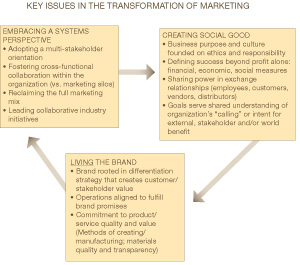
A Fundamental Assumption: The most important difference between companies that are transforming their marketing practice is their interpretation of the purpose of marketing. In traditional practice marketing is about “selling stuff.” This follows the perception of the purpose of the business, which is to create profit. In firms that are transforming or have transformed marketing, marketing is about creating value for stakeholders – not as a means to an end (profit) but rather as the end in itself. Within this shift, profit is the measurement of how well the organization is achieving that end.

Embracing a Systems Perspective - A competence required for this emerging model is the ability to navigate complexity and engage with diverse, complex, adaptive systems. In transforming marketing, this includes issues such as:

Adopting a Multi-Stakeholder Orientation – In transformed marketing, the organization enlarges its focus from stockholders to stakeholders who include investors, employees, customers, partners and society. The intent is not to “manage” stakeholders but to serve them.

Cross-Functional Collaboration – In the traditional paradigm, marketing is frequently siloed and given increasingly tactical focus. In transformed marketing, value creation for stakeholders (marketing) is everyone’s job and requires cross-functional collaboration across departments – finance, human resources, manufacturing.

Industry Collaboration and Partnerships – Organizations transforming marketing are not isolated competitors seeking dominance and hoarding information. Rather they participate in industry collaborations to advance standards or other initiatives for the benefit of stakeholders.

Reclaiming the Marketing Mix – In traditional practice, marketing has increasingly focused on sales and promotion due to an emphasis on measurement. Organizations that are transforming marketing seek to maximize stakeholder benefit through all aspects of the marketing mix (product, price, promotion, distribution/sales). These marketing decisions may not take place in the marketing department per se but through cross-functional collaboration.

Creating Social Good – A radical departure from serving simply the profit motive, to one that says profit is the measure of how much value or benefit the firm creates for stakeholders. This includes issues such as:

Purpose and Culture Founded on Ethics and Responsibility – There’s a constant focus in these organizations around “doing the right thing,” which begins with purpose and a culture that supports ethical action.

Defining Success Beyond Profit – Financial measures are insufficient determinants of success for many organizations who care deeply about their impacts on the environment, on customers, on employees, vendors and more. Whether it’s two, three, four or more “bottomlines” – transformed marketing evaluates success in more than financial terms.

Organizational “Calling” – Those practicing transformed marketing are guided by goals that serve a shared understanding of the organization’s “calling” or intent to create stakeholder (or world) benefit.

Sharing Power in Exchange Relationships – Transformed marketing seeks to create partnerships with stakeholders in which power is shared. This capacity separates these organizations from those that are merely well intentioned, yet feel entitled to cajole customers into decisions that are “good for them” or to “sell what we make” without meaningful input from the customer or market.

Living the Brand – From one perspective brands are “perceptions” that are created to influence purchase decisions. In organizations practicing transformed marketing, however, the brand IS the company, and the company lives the brand. It’s not perception. It’s reality. Branding campaigns seek to create awareness of that reality, not to create it virtually. Elements of this include:

Brand Rooted in Clear Differentiation Strategy – In transformed marketing the brand is rooted in a solid business model that articulates a long-term strategy for creating value for stakeholders distinct from that of other firms. By contrast, head-to-head competition or competition on perception alone reinforces the vicious cycle of promotion to compete, leading to ethical “trade-offs”, and a firm-centric view.

Operations Aligned to Fulfill Brand Promises – The “operational side of branding” means taking the brand deeply into every aspect of the organization. This requires translating the implications of the brand for the day-to-day functions of departments. Representative questions to ask in this process include: What type of person should we hire to reflect the brand values? How does the brand change what our office looks like? How do I need to share information with other departments in order to help them live the brand?

Commitment to Stakeholder Benefit - The “right thing to do” in a transformed marketing environment is a radical commitment to making sure all aspects of brand execution translate into benefit for stakeholders. This includes ongoing reflection and action concerning methods of creating products/services, their features and benefits, the materials they use and the transparency with which the supply chain is managed.

Continuing The Conversation

Although the era of sustainability shines a brighter light on companies who practice marketing in this way, many companies – including ours and our clients’ – have been marketing in the spirit of the emerging model for years if not decades – long before frameworks for sustainability or the triple bottom line were as accessible as they are today. As more organizations adopt social enterprise models and similar forms that blend mission and revenue creation, transformed marketing offers an approach that better fits their values.

Many of the companies who have been pioneering in this model have done so based on the intuitive conviction that it was simply “the right thing to do.” We are fortunate in this time that research, including the studies referenced above, is confirming their collective hunch that a seemingly radical commitment to marketing that works for all also turns out to be a good way to make money. Many today are trying to approach the triple bottom line from a single-bottom-line perspective. Perhaps now there’s enough empirical research to encourage such firms to explore this emerging model more deeply.

There are many stories to tell and many interrelated ideas to unpack as we continue our own exploration. We’d love to hear from you about your experiences, ideas and questions.

Google Profile a Tool for Personal Branding

Monday, June 22nd, 2009

If you are in the knowledge business, your fortune is tied to awareness of your expertise. Developing a reputation for specific expertise or experience is part of the process of personal branding. In pursuit of your personal brand, creating your Google Profile is both a good exercise to get clarity AND a good way to put the word out. I’ve written before about how good Search Engine Optimization drives better marketing messaging because it requires getting clear about keywords. The same is true for optimizing your Google Profile.

Google Profiles, which are free to set up, are indexed by the Google search engine. When an individual searches for your name, your profile will be one of the items the search returns. More than a bio, the profile is a chance for you to optimize for the issues and subject areas you want to be known for.

Questions to ask yourself as you are preparing to complete your Google Profile:

  1. What subject areas are my passion and areas where I want to be considered an expert?
  2. Where do my areas of passion and interest overlap with the market’s needs and interests?
  3. What articles or publications have I authored that are part of those subject areas discovered in questions 1 & 2?
  4. What Web sites am I associated with that support or reflect my areas of expertise?
  5. Do I use terminology to describe myself or my work that others might not understand? Is there a way to explain your terminology concisely or use “generic” language that connects with a broader audience?

For my own Google Profile, I wanted to emphasize my work in developing high-performing marketing strategies that are also ethical and support the values of sustainability. As a result, I’ve included links to papers that I’ve written, Websites where I post information and our blog.

One of the Google Profile fields asks you to name your “superpower.” Although this sounds like a frivolous question it’s actually another opportunity to convey your branding. “Interests” is another area in the profile to include keywords.  My Google Profile is focused strictly on my work so it includes only those interests. Take a look here or Google me: Kathleen Hosfeld and look for the Google Profile link.

Asking yourself what you want to be known for is another way of considering your legacy, and the how you want to change the world. Let us know what you come up with!

Additional Information:
Here’s a video “how to” on optimizing your Google Profile

Marjarg: Marketing Jargon

Thursday, June 18th, 2009

Finding your way through the razzle dazzle

Are you a member of a progressive organization trying to figure out what types of marketing strategies will 1) work for you, and 2) fit your values? If you are then you’ve no-doubt run into a blizzard of marjarg (marketing jargon) that ’s both dizzying and disorienting.  Marjarg outside the world of progressive values is bad enough – buzz, spin, viral, marcomm, Web 2.0, SEO, etc.  When entering the realm of sustainability oriented, or corporately responsible marketing, you may be even more confused.  To get you started, here are a few definitions of marketing terminology you may encounter.

Green Marketing – Green marketing is often used as short-hand for any kind of marketing that attempts to include the values of sustainability. According to the American Marketing Associations, however, green marketing is marketing that focuses primarily on the environmental benefits of either the product/service being marketed or the environmental qualities of the process of promotion/advertising.  Green marketing is typically focused on the product and the promotional aspects of the marketing mix. So far, I have yet to see a comprehensive model of green marketing that takes into account all aspects of the marketing function (product, price, promotion, distribution/sales).

Triple-Bottom-Line Marketing – This is a seldom-used term, but one that speaks to marketing practices that seek to account for financial, social and environment measures of success. As a result of this, triple-bottom-line marketing seeks to address more of these measures in all aspects of the marketing mix. Just as there is no comprehensive model of marketing for Green Marketing there’s even less written about triple-bottom-line marketing.

Stakeholder Marketing – Stakeholder marketing is based on stakeholder theory which asserts that companies are obligated to a variety of stakeholders not just investors, stockholders and owners. Although the argument has been primarily an ethical one, recent studies demonstrate that this orientation makes companies more profitable as well.  The primary stakeholders included are investors, employees, customers, partners and society. Stakeholder marketing is “an orientation toward a firm’s marketing activities that goes beyond consideration of the firm’s immediate targeted consumers to include others that may be impacted by their activities. It considers impacts of marketing activities on a larger base of constituents, and encourages consideration of the impact of these constituents in fashioning marketing activities.”(Gregory Gundlach, University of North Florida). The Aspen Institute has collaborated with Boston University in hosting the Stakeholder Marketing Conference. Exemplary firms that practice Stakeholder Marketing are profiled in the book: Firms of Endearment.

Social Marketing – Social marketing is the application of business-oriented marketing principles and practices typically in a non-profit , government or NGO contexts  to change behavior to achieve a social good.  In practice however, this term is being used as short-hand for Social Media Marketing. Social Media Marketing is the process of engaging online communities like Facebook, MySpace, Twitter, and LinkedIn to generate exposure, opportunity and sales. Social Marketing got its start with nonprofit organizations trying to effect behavioral changes such as reducing smoking, and encouraging the use of condoms. Social Marketing seeks to create behavior change that does not necessarily involve a purchase that benefits the marketer’s organization.

Social Media Marketing – As referenced above, Social Media Marketing is the process of engaging online communities via Facebook, MySpace, Twitter, and LinkedIn to generate exposure, opportunity and sales. Another term for Social Media Marketing is Social Networking. Today, many who are unaware of Social Marketing as a discrete discipline are using that term to refer to Social Media Marketing. Social Media Marketing is not primarily concerned with values, sustainability or the triple bottom line, although it represents a set of tools that may be used by organizations who are.

Service Dominant Logic – Service Dominant Logic (SDL) is used by its authors (Robert F. Lusch, University of Arizona, and Stephen L. Vargo, University of Hawaii) to describe what they consider to be radical reframe of the marketing process. One element of SDL is to redefine everything that an organization sells as a “service” whether it is a physical good or an intangible service or experience.  By “service” they mean the benefit of the good sold.  This shifts the perspective of the seller from one of a manufacturing focus (inward) to a customer/market focus (outward.) The second element of SDL is the notion of “co-creation” of value between the customer and the company. The company consciously gives equal power to the customer in the exchange process through intentional interaction.  While laudable in its intent, SDL assumes that all customers want to co-create their experiences with companies. Real world situations demonstrate that when offered a co-creative opportunity not all consumers want one.

The TARES Test – The TARES test is a five-point test for what the authors call “ethical persuasion.” Published by Sherry Baker, a professor at Brigham Young University, and David L Martinson, of Florida International University, the TARES test seeks to establish robust principles for ethics in marketing and to support the creation of a more ethical approach to persuasion – particularly commercial persuasion such as that which takes place in the marketing process. The TARES test consists of five principles: Truthfulness (of the message), Authenticity (of the persuader), Respect (for the persuadee), Equity (of the persuasive appeal) and Social Responsibility (for the common good).The TARES test is included in some marketing and advertising text books and can also be found here. The TARES test is used primarily in evaluating advertising and promotional materials, but could also extend to sales and other persuasive business speech.

Do you have another example of marjarg or have a question about a term? Contact Us. We’ll try to answer your questions and respond to your comments.